

What Can B2B Marketing Budgets Tell Us About Events in 2021?
Here at Outsell, we continue to lead the industry in analyzing and benchmarking the impact of COVID-19 on events. Earlier this year, I blogged about the general outlook for the events industry. The following is what the tea leaves tell us about marketing budgets and what’s happening to budgets in 2021. As always, thanks to our VP & Lead Analyst Randy Giusto, who’s been relentlessly tracking events since the pandemic started.
In December and January, Outsell surveyed 235 US marketers with knowledge of marketing budgets or the authority to allocate them in 2021. The findings below are a result of our analysis of their responses.
B2B Budgets Go Up but with Some Challenges
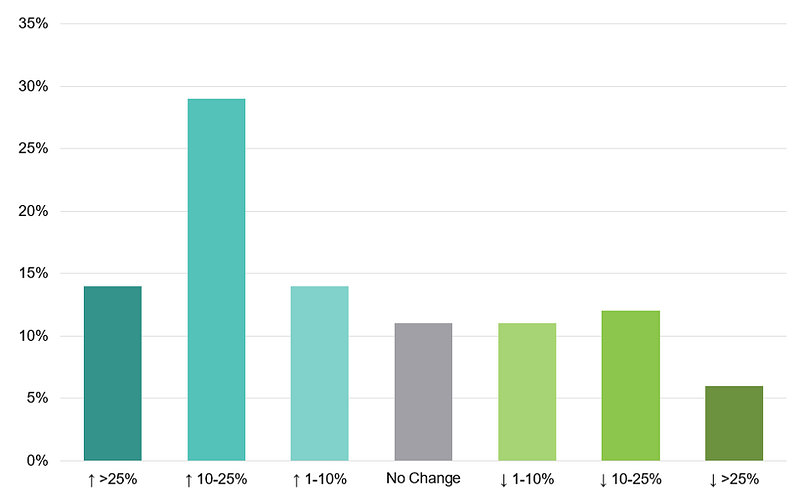
The good news is that more of our survey respondents expect increases in 2021 than decreases (Figure 1). However, many face budgets at similar levels to those of 2020, which were already difficult. And nearly a third will see their numbers go down.
Figure 1: B2B Budget Change for 2021
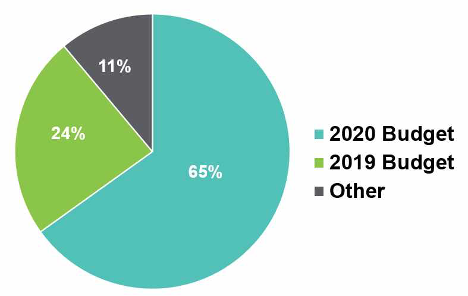
Just under two-thirds of respondents said they were basing their 2021 budgets off 2020, and about a quarter are using 2019 (Figure 2). It’s important to point out that even if budgets increase in 2021, many will be based on reduced budgets from 2021 due to the pandemic, so the actual numbers this year may still be small.
Figure 2: 2021 Budget Baselines
Slow Return to Pre-Pandemic Budgets
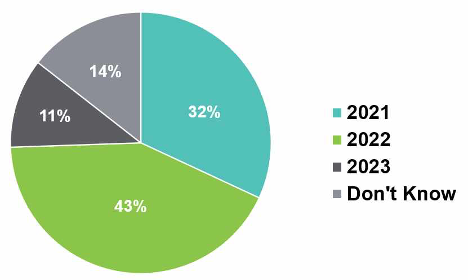
Like many of you, we’re excited about the promise of widespread vaccination and a possible return to something more closely resembling normal very soon! But vaccination is going to take time, and marketers recognize that it will be a while before we get back to the budget levels we had before. Only around a third expect pre-pandemic levels to return this year, whereas more than two in five (43%) expect it next year, and 11% say it may not be until 2023 (Figure 3). Much of this depends a lot on industry segment and even specific customer requirements.
Figure 3: Anticipated Return to Pre-Pandemic Budget Levels
Where Did Event Money Go?
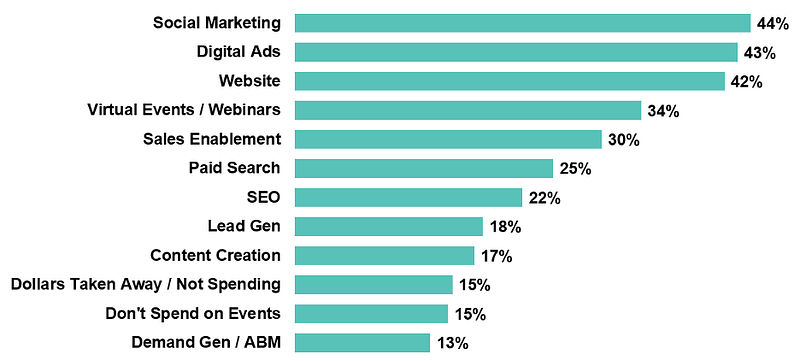
We asked marketers if they would be reallocating the funds they had previously spent on events, and if so, where. The data shows that there’s no shortage of places to stick those dollars, with social, digital ads, and website work leading the way. Virtual events came in at number four, instead of number one, so the net-net is that the money is not staying in events. The good news is that only 15% of marketers see these dollars going away, but the challenge for those supporting marketers through events is that they must also provide offerings in these other areas to get back the revenue they once had.
Figure 4: Event Dollar Funneling
Advertising and Branding on the Rise
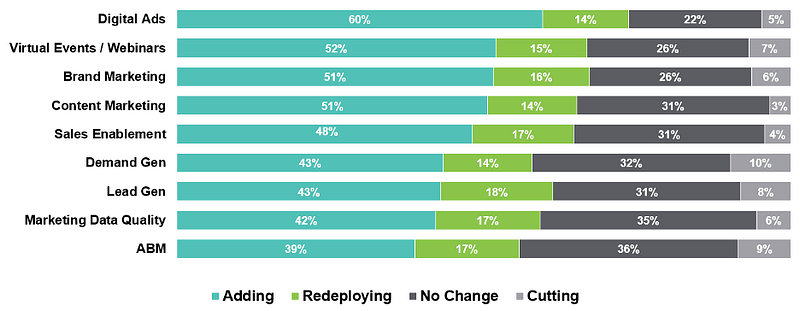
There’s no question that digital ads are booming once again, with 60% of respondents increasing spend here and only 22% decreasing. Branding-related activities will also snap back as companies look to increase audience reach through top-of-funnel marketing efforts. Content marketing efforts remain solid in 2021; B2B marketers will also spend more on the trifecta of demand gen, lead gen, and sales enablement this year. We’ve also heard about a resurgence in programmatic digital advertising efforts, and content is expected to be in high demand due to B2B marketers looking for partners to satisfy content needs.
Figure 5: Investment Areas
Observations
It’s clear that while 2021 won’t look like 2020, it also won’t look like 2019 or earlier years. COVID-19 will have a lasting effect well into 2022 and 2023. Even if the virus were to disappear suddenly, spending at 2019 levels would not just snap right back. Many companies are much smaller now than they were just a year ago. Spending remains tight, and it’s also more closely watched. Marketing and finance teams must measure everything daily and adjust or course-correct in the moment. Marketers and advertisers also have no excuses for not having the right data at their fingertips now.
B2B marketers will need to make do with the budgets they have for 2021. They’ll still need to plug the events gap with virtual and hybrid efforts until in-person events get back on firmer ground. They’ll need to master all the tools in their marketing stacks, too, making sure that they’re firmly connected, the analytics sing through them, and good, qualified leads fall out of them. Failure to do this will result in another challenging year.
For companies selling services and data into the marketing function in 2021, Outsell recommends several actions. For one, providers will benefit if they can ingest their customers’ data, mash it up with their own, and produce customized audiences to take to their own customers’ agencies to help drive a campaign. Providers must maintain focus on virtual events until in-person can ramp back up, exploring ways to redeploy skills and resources dynamically as required by the marketplace. Companies will benefit from moving away from selling transaction-based, single-point solutions and focusing on direct needs. Also, always remember to deliver on value because there’s no shortage of options for a customer to explore to take the place of an incumbent that fails to deliver on customer needs and value.
We’re always publishing on this topic for clients on the Outsell Community Platform, including the following recent relevant analyses:
- Virtual Event Best Practices: Attendee Engagement, Networking, and Matchmaking
- Virtual Event Best Practices — What’s Impacting the Return to In-Person and the Decisions to Make
- Virtual Event Best Practices — Shifting Team Structures and Addressing Skill Gaps
- Virtual Event Best Practices — Event Benchmarks
If you’re not a client, please contact us to explore becoming a member today — we’d love to hear from you!