

Welcome Back?
Last week we marked the official anniversary of the COVID-19 pandemic, which was declared by the WHO on March 11, 2020. Of course, by the time they made it official, most of us could already see the writing on the wall. Still, though, it’s an important milestone — if perhaps an ominous one.
For the last year, we’ve all had to deal with unprecedented change — including change in what is changing. After being in “survival mode” for much of the last year, the roll-out of vaccines is prompting growing optimism that 2021 will mark our collective emergence from a time of unprecedented difficulty. As part of this burgeoning transition, CEOs and their HR execs and teams across the data, information, and analytics industry are pondering choices about returning to the office.
To keep a pulse on these issues, we surveyed CEOs, HR leaders, and other senior executives, receiving 129 responses to our questions about how they were approaching the question of returning to offices, what plans they were developing, what criteria they were using to determine who returns and when, and the changes they have made or are planning.
We shared our insights with clients earlier this week and are sharing with the broader industry given the importance of this topic. Here’s our lens on what’s taking shape.
General Strategy for the Return
Universal remote working was forced on most information businesses over the past year but has largely worked well. Nearly 80% of respondents now plan to designate more of their employees as primarily remote workers or require them to spend fewer days in offices (Figure 1).
Figure 1: Strategy for Returning to Offices
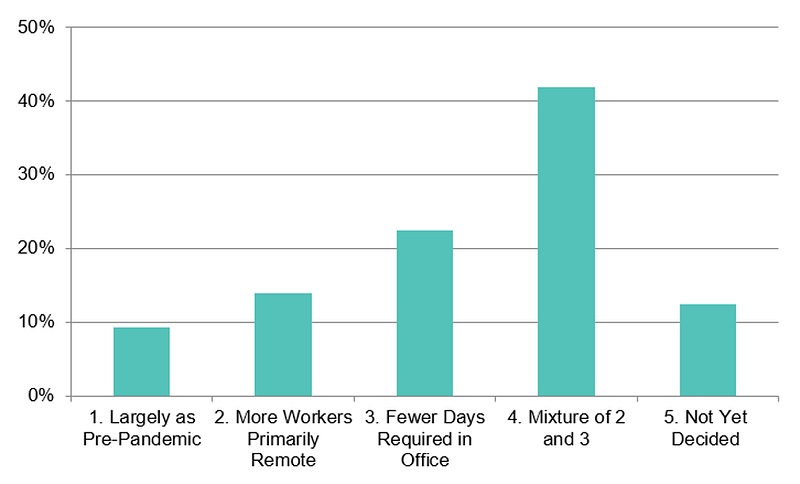
Nearly 20% of those who plan to increase the number of employees designated primarily as remote workers will at least double that proportion, with a few planning to increase it by up to 500%.
Key Criteria
With so much uncertainty about the pace of vaccination, constantly morphing national and local regulations, and uneasy employees still dealing with a lot of personal stress, how do leaders decide if and when to return staff to offices? The most frequently chosen criteria were the progress of vaccination programs (65%), employee feedback (61%), regulations in force (55%), and local infection rates (43%). Figure 2 also shows the single most important criterion for respondents.
Figure 2: Most Important Criterion for Allowing Staff to Return to Offices
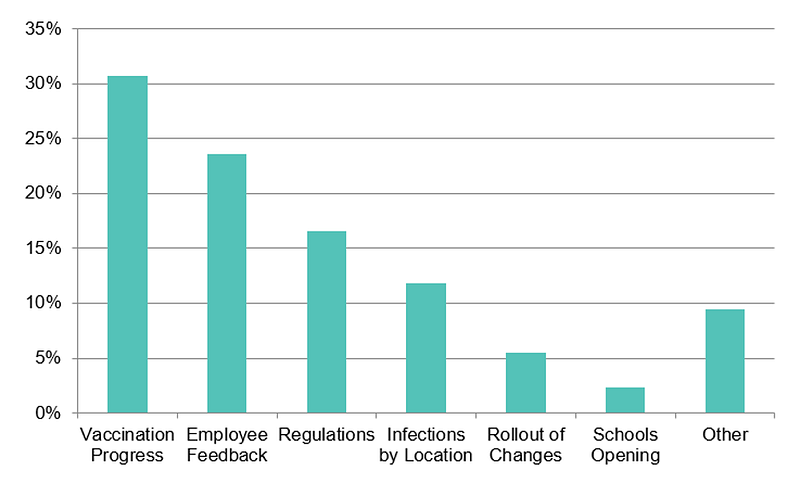
We found that answers depended a lot on company size. Companies with over 1,000 employees and the most additional offices considered local infection rates to be the single most important factor. Companies with fewer than 20 staff most heavily weighted employee views. Another factor cited was the need to determine potential liability when staff return.
Planning for the Return
Under half of respondents have finished or nearly completed their planning, while nearly as many are just getting started or haven’t started at all. Only a little over one-third have established a policy or are close to finalizing one for how to deal with employees who don’t want to return to the office when required to do so. We asked respondents what their policies will be (Figure 3).
Figure 3: What Will Policy Be?
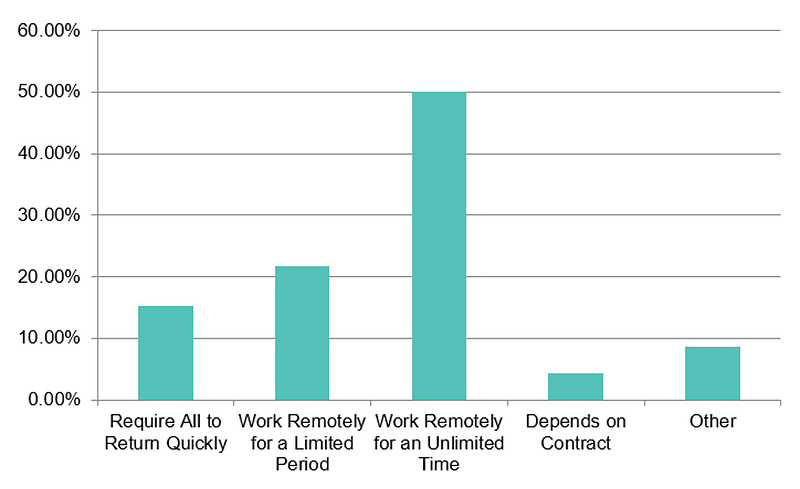
Allowing employees to work remotely for an unlimited period was clearly the favorite option, reflecting well-developed work-from-home policies that predate the pandemic. Employers also desire not to put undue pressure on staff. Overall, companies with more than 1,000 employees are ahead on overall planning for the return to offices but less far along with crafting policies on handling those who don’t want to return. Almost 70% have not started or are just starting to set their policy, maybe due to dealing with many more offices in different places.
Another area where only about half (51%) of respondents have finished or nearly finished their planning is making changes to offices to make them “COVID-safe.” Just over a fifth said those changes weren’t required at all, a number that includes those that are already fully remote or don’t intend to return to offices at all. Many are planning or implementing familiar measures: more spacing, improved ventilation, well-signed one-way systems, access scheduling and control, regular cleaning, etc. Some have installed or are considering plexiglass screens between desks; another mentioned new protocols for conference rooms.
Vaccination Policy
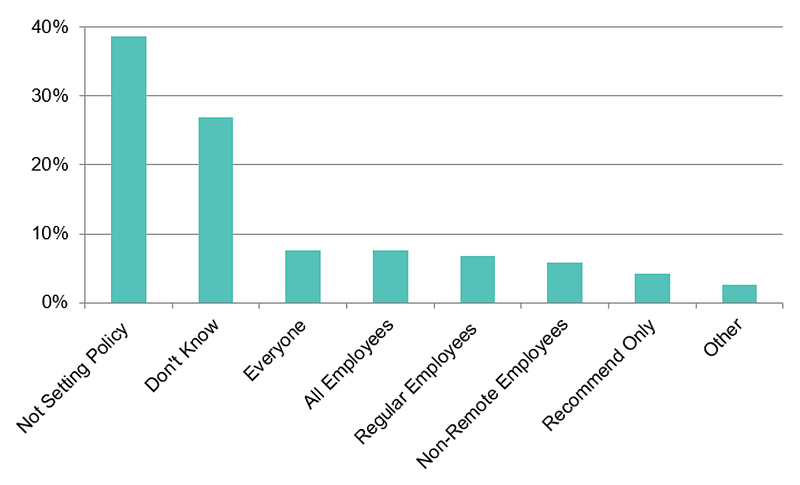
We also asked what the policy would be for vaccinations as a condition for accessing the office (allowing for those who cannot be vaccinated for medical or other reasons). Businesses want to be sure that their policies conform to applicable employment legislation and that they are protecting both employees and the companies themselves.
Just over a quarter will require it for all employees working in offices, with a small group of those requiring it for visitors, too. Two in five aren’t planning to have a policy, and just over a quarter don’t yet know what their policy will be, with a number waiting for legal advice and regulatory guidance.
Figure 4: Who Will Require Vaccination to Access the Office?
Office Space
Many businesses have taken advantage of remote working to review office footprints and are planning to reduce. We asked respondents how they are changing the amount of office space they have in response to the pandemic (Figure 5).
Figure 5: Changes to Office Space
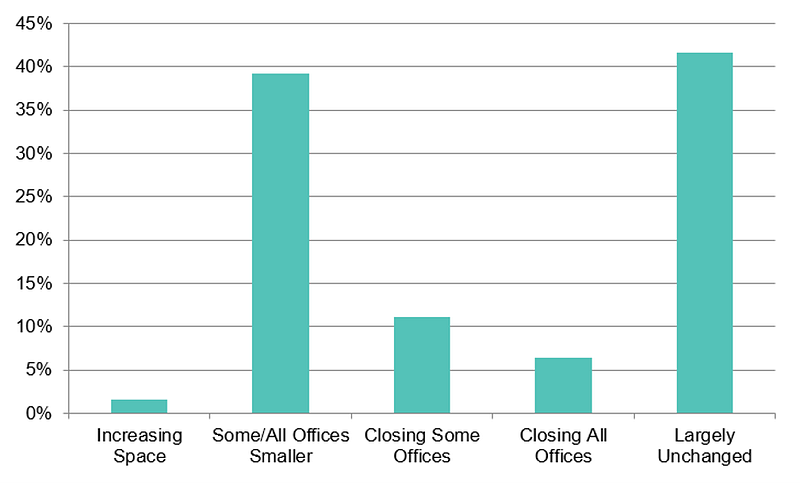
Cost savings are clearly part of this equation, as are staff wishes. Well over half are taking some action to reduce space, but it’s interesting to see 40% leaving things largely unchanged, at least for now. One firm had been pretty sure it would give up one of the two floors it occupies but has decided not to do that yet in order to provide more space for returning employees and see what new patterns staff settle into. Another had six offices when the pandemic started and will be down to one when it ends.
Observations
Businesses overcame initial skepticism about remote work last year, learning that it could generally keep them just as efficient and productive as before. There will be more flexible and remote working in the future. But this is not new: the US BLS reported that in 2019, 23.7% of employees were working at home on an average day for all or part of the time. Of course, here at Outsell, we’ve been working largely or entirely remotely for decades. We know from experience what many respondents told us: that there are pros and cons to working virtually. It may also be that some employees will enjoy exploring both office and remote work to find a balance that works for both them and their employers, something they couldn’t do during the pandemic.
Returning to offices will remain a very mixed picture, depending a great deal on company specifics. It will also be shaped by events beyond companies’ direct control: the evolution of the coronavirus, government regulation, and the conflicting pressures of a widespread longing to resume social contact of all kinds while experiencing anxiety about doing this.
Leaders will need to be adaptable with their approaches and keep their employees informed and involved as circumstances and plans evolve. Two-way communication is key.
Keep options open and stay flexible: agility is the mantra of the day. Good luck and stay well.
We’re always publishing on this topic for clients on the Outsell Community Platform. Not a client yet? Please contact us to explore becoming a member today! We look forward to hearing from you.