

Software’s Exaggerated Demise
There is a lot of coverage about the software industry’s demise due to AI. Just like Mark Twain’s famous saying, “reports of my death are greatly exaggerated”. So it goes with software.
With the Outsell Value Pyramid we’ve been analyzing basic data up through intelligent systems (and people-based advisory) with recognition that agents and generative AI are the ‘river’ that runs through it. Machine learning, AI, now generative AI and agentics operate up and down the spectrum.
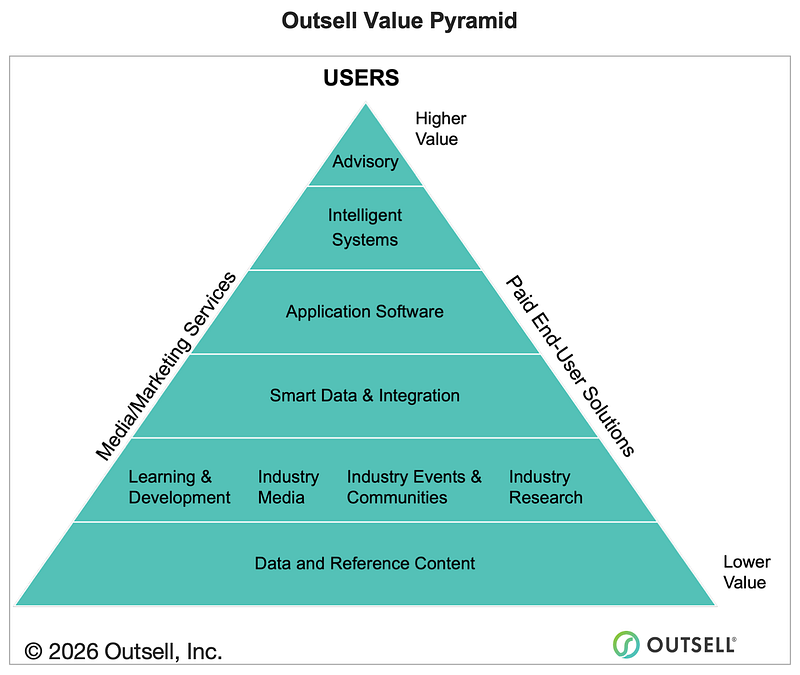
Every layer has benefits and risks associated with technology — used wisely, poorly, or by someone else disruptively. Just as basic editorial has been commoditized over the years — (think news) so too has other parts of the industry. But that doesn’t make them go away.
It just means there is change afoot and businesses and money are at risk. It’s the same with ‘application software’ and it’s not going anywhere — unless Claude destroys it for you.
Two articles caught my eye and there are hundreds on this topic — all over LinkedIn, in tech media, Wall Street pundits’ analyses, and research and advisory firms. The tea leaves point to some important distinctions. One article analyzes winners and losers in four categories:
• “Vertical” software that serves specific industries
• “Horizontal” software that serves a range of businesses
• Cybersecurity and identity-verification software
• Software-engineering software
Another shares Marc Benioff’s views and “why the software bears are all wrong.” I am not taking the WSJ’s word for it. You simply can’t study, live in, be around high-tech for the entirety of one’s career and not see some other truths. Sure, vertical and horizontal is important. In Outsell’s opinion there are three other things that matter:
- Market Position: Market share leaders have a better chance of staying in the game (a la Mr. Benioff) as do hyper niche players. Hyper niche players with dominant market share are nearly golden unless self-inflicted or external left-field events (think Covid) happen.
- Third Party Content: Software that has what we have long called ‘water in the pipes” (third party content in the solution) has better barriers to disruption. It’s one reason pureplay software firms are at risk.
- Customers: Many customers don’t wake up in the morning dying to tear out long-installed systems nor do they wish to vibe code their solutions. You have to really mess-up to get them to pull the plug.
They aren’t in the business of developing application software. They want to build or fly planes, launch life-saving drugs, sell cars, or rent them in the case of Claude gone rogue. They want to treat patients, sell clothes or cosmetics, or any of the thousands of things NAICS codes classify us as doing.
Does my local vet want to save dogs and cats and support their owners through stressful times, or do they want to vibe code the software that is their equivalent to an EHR and then plug in all the third-party data that supports their practice and vets to be better?
And so a finicky thing called customers (which too many of the tech crowd under-estimate) simply don’t want to build solutions that they can better buy, license, and tailor. Regulated industries are even more pronounced about this.
Sure, users are going to do their thing in big enterprise with guardrails (we hope.) But they aren’t going to vibe code the application software industry into oblivion.
And start-ups will emerge like blades of grass whose founders will vibe code the solutions they need. We heard several case studies about that at RevvedUp 2026. Next gen entrepreneurs want to take out the dominant players and the slower incumbents because ‘they can.’ But don’t look for Boeing, Pepsi, or your local vet to rip out the great tools they are accustomed to. And for those entrepreneurs? They have disdain until they end up selling to a strategic or partnering with them to access channels to market. It happens all the time.
So our prediction for software; the big incumbents will likely do just fine. The specialty niche firms will too. It’ll be like the news industry. FT, WSJ, NY Times… large dominant players are still here even after a beating. Small players — our local Carmel Pinecone , Lookout Local or the Stanford Daily are all thriving. The murky middle? It’s never a happy place to be. Just look at LA, SF, Dallas, Chicago, Boston, and next tier towns and the dailies that are a shadow of themselves. That’s our telescope into the future.