

Gone Fishing
Decided to take a hiatus from Instagram for a while until the dust settles and we have some truth about what happened with our sensitive tax info going to Meta from the likes of H&R Block.
Being congruent about my concerns, and walking the talk is important. Also, I’m willing to give it a fair shake, assuming we ever get the truth about what’s happening in our world where we have long become the product that gets monetized. Right, wrong, or otherwise, I was never on Facebook or Twitter and adopted LinkedIn for professional purposes. For whatever reason, it felt more trustworthy and when Microsoft bought it, it seemed the “enterprise focus” made for a better home.
When I published my two books and began designing jewelry the firm who supported marketing was adamant that avoiding Facebook and Instagram was not an option. Adamant that I didn’t want to participate, we met in the middle with Instagram. I was uneasy after Cambridge Analytica, but it wasn’t until the tax return situation that enough was enough.
And my beef wasn’t only the loss of privacy but the sense that digital marketing had lost its way. Discoverability is one thing, and I’m all in. Harassing people, playing whackamole with relentless email marketing, and harvesting personal data to manipulate campaigns or sell more about us to marketers? Nope. Not up for that and then in came Chuck Richard last week.
We went back and forth a few more times and he elaborated more about the concepts that flip the marketing model and shared the following:
Here are several related items that really help make it concrete. Something that is so counter to all modern practice can be hard to grasp at first telling!
1. Great example of life the way it should be, in the Intention Economy, in the lead paragraph of this article:
In The Intention Economy, a car rental customer should be able to say to the car rental market, “I’ll be skiing in Park City from March 20–25. I want to rent a 4-wheel drive SUV. I belong to Avis Wizard, Budget FastBreak and Hertz 1 Club. I don’t want to pay up front for gas or get any insurance. What can any of you companies do for me?” — and have the sellers compete for the buyer’s business.”
Contrast that with all the rental car companies spamming everybody constantly just trying to hook 0.001% of the recipients into using their offer. Which way works best for all concerned?
2. Glorious Freedom for the Sales Function
In the Intention Economy, salespeople get glorious freedom from the two parts of the sales function they dislike the most: 1. trying to identify a prospect out of the hundreds of millions of candidates. 2. pre-qualifying the prospect.
When the customer “publishes” exactly what they want, only when they want it, and opens up to incoming sellers who meet his or her criteria, those steps 1 and 2 disappear and sales gets to do what they love the most: engaging personally with this pre-qualified, self-identified prospect, and collaborating & negotiating with them to arrive at the best products and services to meet their stated need.
3. Video of Doc Searls at MIT Media Lab
There is a gem in the YouTube video. The video is long, 1 hour 17 minutes, and is a full lecture Doc Searls gave at Harvard Law School, with a long introduction by Ethan Zuckermann. But Doc Searls begins by showing a hilarious — and incredibly insightful — 2 minute 30 second skit by The Onion that I’d never seen. It begins at 8 minutes 25 seconds into this video — to help you find it.
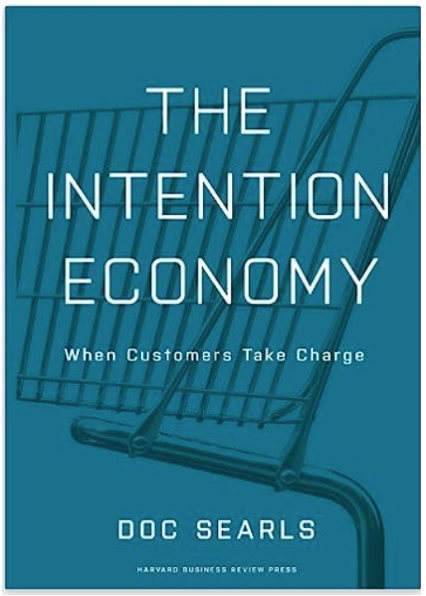
4. The landmark book published by Harvard Business Review Press 2012 — The Intention Economy: When Customers Take Charge
Ah, Chuck — if all this were only so. It’s time to flip the marketing model.