

It’s a Good Year to Reconsider Event Marketing
COVID-19 upended the market for in-person events due to marketers freezing spending. Outsell recently surveyed 235 US marketers to learn where that spending went and to better understand marketer perceptions about the return to in-person events and what virtual events must do well until then.
For over a full year now, we’ve been living with the pandemic and adjusting to all the changes to our personal and business lives that it has brought with it. The events industry has been hit particularly hard, so it’s been a key focus for us here at Outsell. VP & Lead Analyst Randy Giusto has led this effort, talking to people in the industry constantly over the entire period. Last week, we looked at B2B marketing budgets in 2021 and what they tell us about events this year. Today, we examine spending shifts and look at important considerations for both in-person and virtual events in the year to come.
Vaccine rollout is progressing steadily in many nations, but the details vary from country to country and state to state. This means marketers must plan for a short-term scenario featuring virtual events while in-person events return over time. B2B marketers and marketing services providers who support them are focusing on figuring out when and how in-person events return, what concerns still remain, and what virtual events must do in the meantime.
Marketers Shifting Event Dollars to Top of Funnel Activities
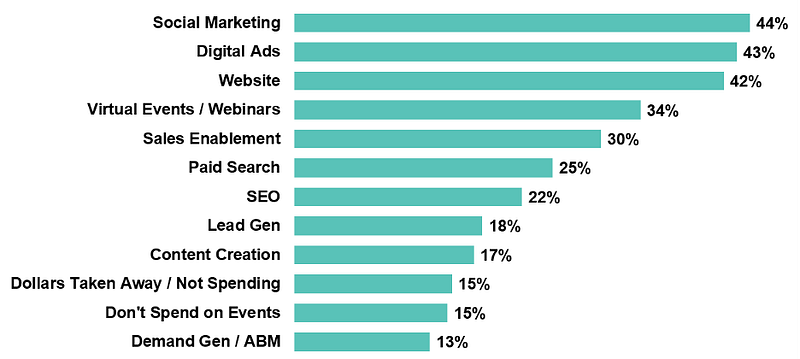
We asked marketers where money spent previously on in-person events will flow in 2021. Figure 1 shows that it clearly won’t flow into virtual events directly, with social, digital advertising, and website work the top three areas. These areas represent TOF activities meant to produce names.
In 2021, we see a rebound in focus on new names by marketing, on net new logos by sales, and on activities that enhance both goals. Marketing services providers will need to support these needs through well-organized TOF and MOF work to help their customers fill the top of the funnel once again.
Figure 1: In-Person Event Dollar Reallocation Emphasizes TOF Activities
Many Still Betting on In-Person Events in the Second Half
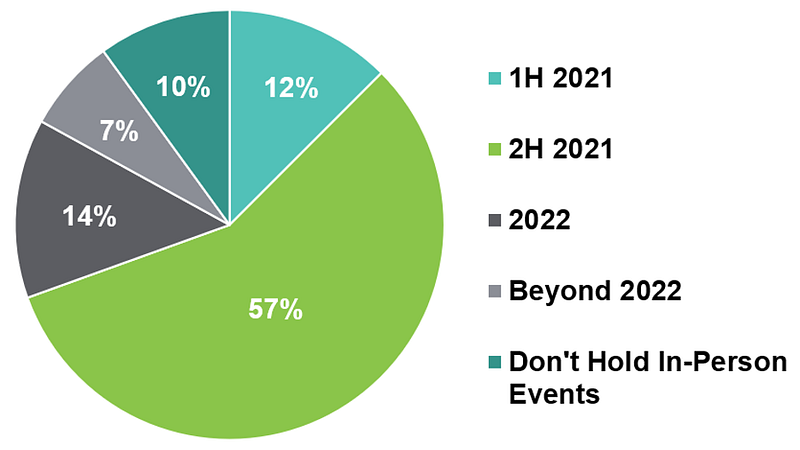
It’s not surprising that many marketers still hold out hope for the second half of this year for in-person events. We’ve also heard from some companies that these efforts will focus more on smaller regional shows to which attendees can easily drive.
Some organizers now expect 30–40% of previous attendance levels for the first year back. Global events appear even more challenging due to visa restrictions based on health and safety issues. Marketers hoping to hold in-person events this year, and the companies supporting them, need to ensure that the experience is a high-quality one, benefitting attendees, sponsors, and exhibitors alike.
Figure 2: When In-Person Events Will Return
Some Top In-Person Concerns Are Controllable, While Others Are Not
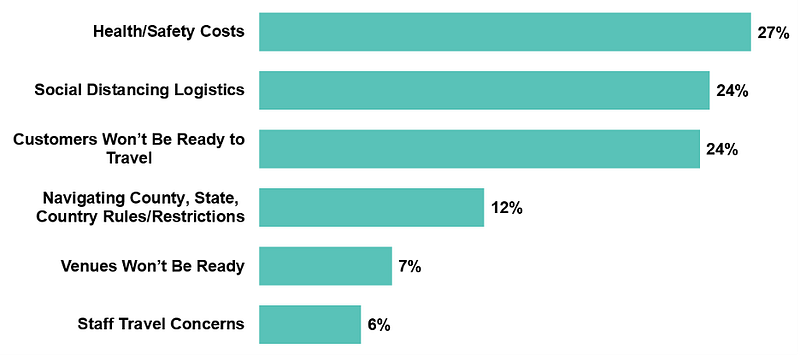
We next asked marketers about their top concerns for holding in-person events. Health and safety concerns and the logistics of social distancing led the list, as the two go hand in hand when it comes to successfully running in-person events in the pandemic era. It’s also important to understand that marketers and event organizers totally control these two areas of concern, but not issues such as the willingness of customers to return once again, government rules and restrictions, venue providers’ readiness, or their own staff’s travel concerns.
Based on our observations, testing is not included in the budgets for safety and social distancing but represents another wrinkle to holding events during a pandemic. Even as vaccination levels increase, marketers will still need to assure attendees that they’ll return to a safe environment.
Figure 3: Health, Logistics, and Willingness to Travel Top Concerns
Virtual Events Must Cover a Wide Spectrum
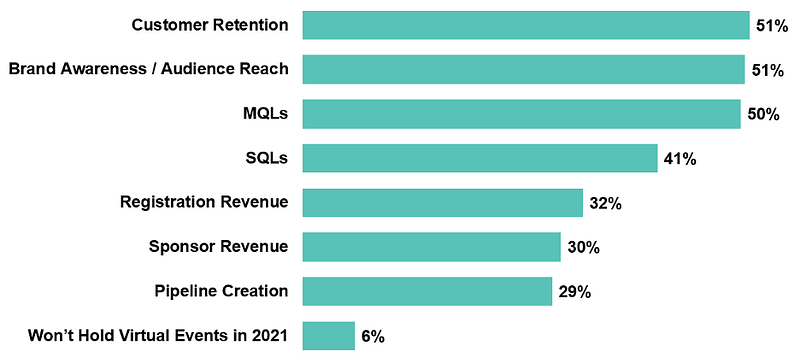
We asked marketers to identify their top three objectives for virtual events this year. These events must drive brand awareness as a TOF activity, MQLs for MOF goals, and customer retention and SQLs for BOF goals — a wide spectrum to cover.
Many event sponsors use in-person events as a door-closing experience (to close a highly qualified lead they meet at the show), but virtual events function as a door-opening experience for sponsors to meet entirely new people. Some sponsors will remain skeptical of virtual events because they produce the wrong kinds of leads and will need other event avenues to drive MQLs and SQLs.
Figure 4: Retention, Awareness, and Leads Top Objectives for Virtual Events
Observations
Marketers must weave their event-related efforts into a different web in 2021 to secure existing customers while snagging new ones for themselves and for sponsors. Interest in TOF activities is returning as marketers look to fill the funnel once again for sales, though some event sponsors will still want qualified leads they can close. The pandemic narrowed the spotlight on the funnel last year to focus on the bottom, but that light is widening now as marketing tries to return to somewhat normal activities: Budgets remain tight and staffing is constrained.
Unlike in years past, when marketers largely spent and measured their budgets quarterly, in 2021 they must measure and adjust in real time because the business demands it. This goes for their event-related activities as well. While some may ease back into in-person events this year, they still need to plug holes with virtual events and webinars, depending on the needs of both sales teams and sponsors. Marketing services providers need to recognize these shifts happening in event marketing and find ways to help customers do more with lower levels of internal resources.
Companies selling services into marketing will want to refocus some of their programs to drive TOF performance. Emphasizing demand gen offerings can help B2B marketers create brand and event awareness and attract new people to both virtual and in-person events. And while virtual events dominate, nurture them, and help customers build content that informs, educates, and draws people across the buyer journey, which will encourage TOF leads to turn into tomorrow’s SQLs.
Companies must also help marketers match event type with sponsor need; they need to redirect sponsors to webinar-focused work, which is more MOF and focused on warmer leads by nature. Finally, marketing services providers can really help their customers by helping them think backwards: Help them identify their goals, and then get them to work backwards by identifying the focused content, email drip campaign strategy and timing, and personalized messaging needed for the desired outcome.
We’re always publishing on this topic for clients on the Outsell Community Platform, including the following recent relevant analyses:
- Best Practices for Perfecting the Virtual Event Content Mix
- B2B Marketing Budgets: The Return to Normal Looks Choppy
Not a client yet? Please contact us to explore becoming a member today! We look forward to hearing from you.