

Outsell Case Study — Pricing Information Services
We’ve been writing about the Outsell Growth Framework, and we’ll continue the series with case studies that are important for executives operating data, information, and analytics businesses.
One of the questions I’m asked most often is: “How do I price my information service?” Companies in our industry too often “guess” at pricing, which has a lots of permutations in our industry, including a propensity to discount.
We recently helped a couple of CEOs in different information services businesses price their offerings. In business information/paid information services there is a hierarchy of value that drives price. To get started, we made sure they asked and answered the following questions, which you can answer as well:
· What is the target market for your information offering (by primary role and primary vertical industry)?
· What is the solution designed to do? How does it do it? Does the solution save money, make money, or mitigate risk? If it simply improves productivity, you’re not in the zone yet.
· How dynamic or static is the offering?
· What is its primary value proposition and competitive differentiation?
· How do you anticipate packaging and what pricing models will you use (enterprise, workgroup, user, transactional, or subscription)?
· What do you imagine the price to be?
· Does this offering replace those of competitors, existing ways that customers behave, and how users have been conditioned to pay? You must know how they’ve been conditioned before you set your price.
· Is it a standalone solution, a workflow solution, or a solution that plugs into another platform (think data in CRM via API)? Or is it data and/or information only?
The diagram below shows what drives value for price and higher prices in our industry:
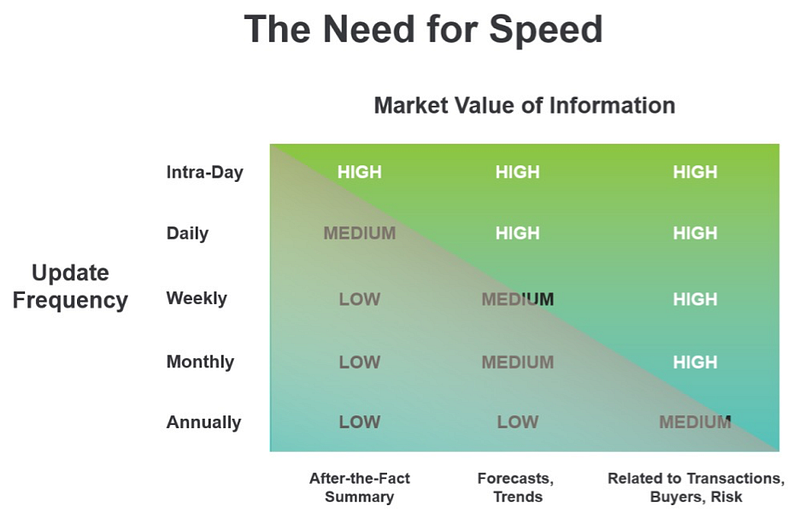
We think of pricing not only on the continuum above but also on the continuum of value:
· Are you providing basic data and insight (news/headlines/reporting, data about companies)?
· Are you providing additional insight, derivative data/insights or third-party data?
· Are you delivering a workflow solution to help customers make decisions at the point of need (software/enabled content)?
· Are you delivering predictive insights about what will happen?
· Are you delivering prescriptive insights about what to do?
The deeper you are on the continuum and the more you immediately affect/impact money flows, the more value your solution has and thus the more you can charge.
You must understand the value you’re delivering and the competitive landscape (or DIY landscape) you’re interrupting. Without that, you cannot accurately set pricing for information solutions. There are sophisticated models for doing conjoint analysis to have customers trade off features — what’s important and what they’ll pay. In this day and age, we don’t think deep survey research is the best way to quantify price.
Know what your offering does for whom and to what benefit. Know why you’re better or cheaper or offer more value for the price than your competition.
Know how your offering helps your users save or make money.
Know how your customers have been conditioned to pay.
Then set your price, test, and iterate. Remember too that it’s easier to set a price too high and bring it down than to start too low and try to increase it.
And please, whatever you do, don’t discount. Lower your prices if you must, especially during a pandemic. Better yet, add more value. But please do not discount at the end of the day, month, quarter, or year. Discounting is a scourge because it trains customers to postpone buying ’til the end of the month, quarter, or year. It also tells them that everything is negotiable, which can become a race to the bottom when competitors start competing on price to beat each other to the deal. SaaS companies are notoriously bad at this, and it’s a stain on the industry. Price for what you do and do it well. Happy pricing!