Outsell Growth Framework — Step 3
Step 3: dIPDL Minimum Viable Product (MVP)
Before all heck broke loose with COVID-19, we began sharing the Outsell Growth Framework, providing a step-by-step guide to growing your data, information, or analytics business. Our first piece focused on the framework itself and explained how to place your business in a value chain. The next step in the Framework was all about doing strategic planning and what a good strategic plan contains. We spoke about the need to keep plans agile and that’s certainly been driven home this past month — in spades.
Get cracking to evaluate every assumption, toss out those that are moot, and plan scenarios. It’s essential to weed out from the portfolio anything not profitable or too costly for this environment, but keep the focus on product development and continuously improving what’s core. Recessions are frequently times of great innovation, and that holds true now. There is a lot of innovation taking place “on a dime” right now, and it’s important to keep that flowing. Whether we’re in a downward cycle or not, product execution still has to happen. It’s time to kick into the next phase of the Outsell Growth Framework, which is to build and monetize your solutions.
The heart of the business of data, information, and analytics is the set of products and services that the company produces, where data is embedded in state-of-the-art offerings. It is now time for the business to operationalize the strategy by building or improving and taking to market the solutions it articulates in the strategic business plan. Quite simply, it’s time to execute the data and Information Product Development Lifecycle (dIPDL) process.
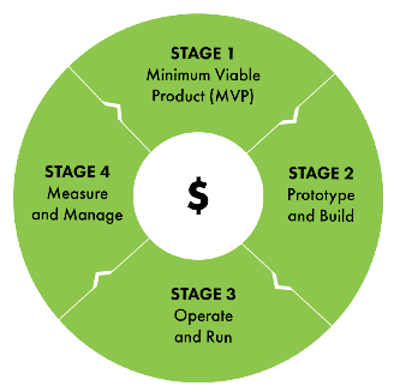
dIPDL operates in an agile framework, recognizing there are typically multiple offerings at different points in the lifecycle in any company at any given period. It has four stages:
1. Minimum Viable Product (MVP)
2. Prototype and Build
3. Operate and Run
4. Measure and Manage
The cornerstone of executing dIPDL is product management, the lynchpin function in today’s modern data, information, and analytics enterprises. Product management is more necessary today than ever before.
Stage 1 of dIPDL is creating a Minimum Viable Product (MVP), the purpose of which is the systematic generation of ideas for new or improved data, information, and analytics solutions. These are typically manifested in wireframes that render the idea in a visual concept in order to begin getting customer feedback.
This is the time to generate a lot of ideas, given the need for speed. Pick those that will rise to the top in terms of time to market and time to money and which are executable, then experiment and proceed. Get the MVP into a beta and get going. Do it, and do it fast, as the need for speed has never been greater than it is today!
Remember the words of one of my favorite CEOs, David DeWolf, author of The Product Mindset: Digital products are never done.
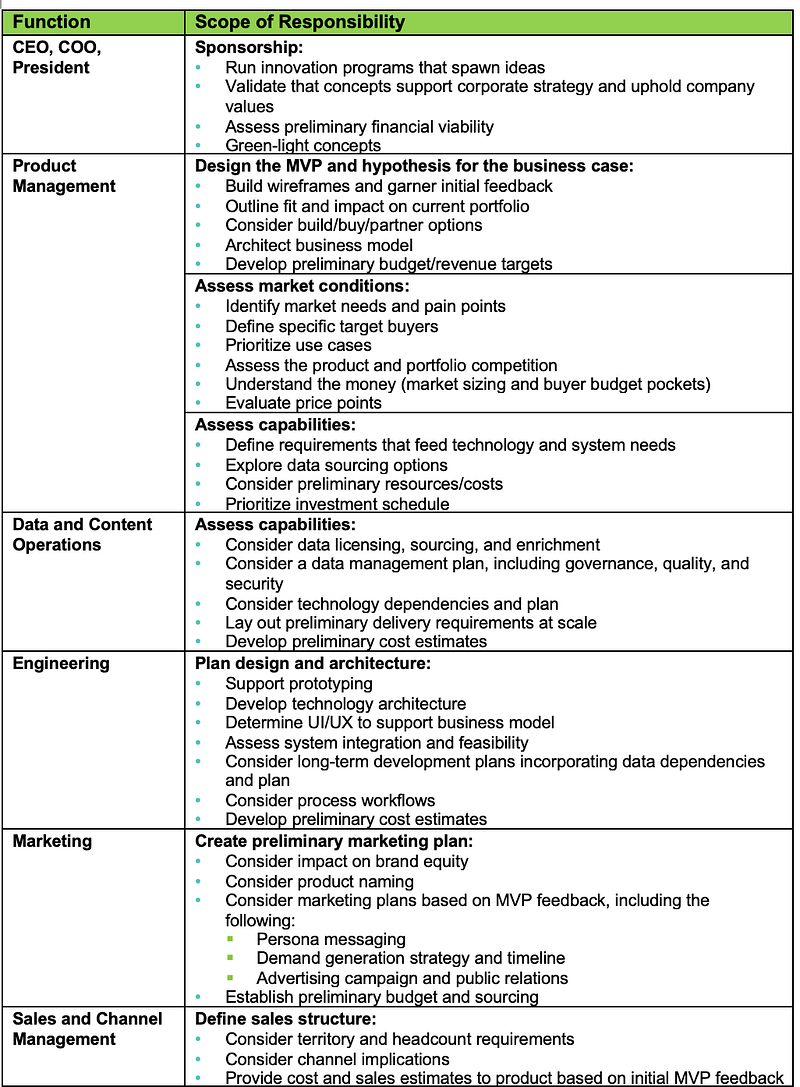
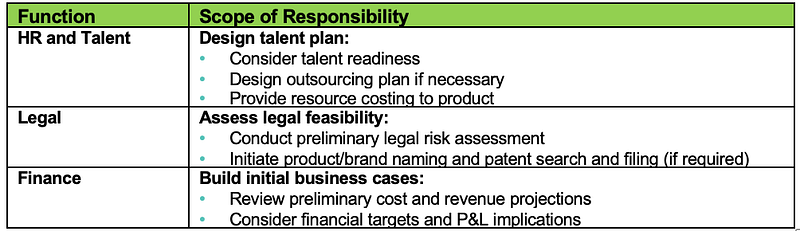
Below are the functions and responsibilities for this stage.